
Cathode Ray Tubes and the Dawn of Modern Eddy Current Testing
Long before digital data acquisition systems, computerized impedance-plane displays, and automated flaw detection, CRT eddy current testing instruments used cathode ray tubes to visualize electrical signals. These early displays helped inspectors interpret signal amplitude, phase relationships, and electromagnetic responses.
For generations of nondestructive testing professionals, the CRT was more than a display. It provided a window into electrical and electromagnetic behavior, allowing technicians and researchers to observe signal amplitude, phase relationships, and changes that would otherwise be difficult to interpret.
The development of CRT-based instrumentation helped establish the visual signal interpretation techniques that remain fundamental to modern eddy current testing (ECT).
Early CRT Applications in Experimental Mechanics
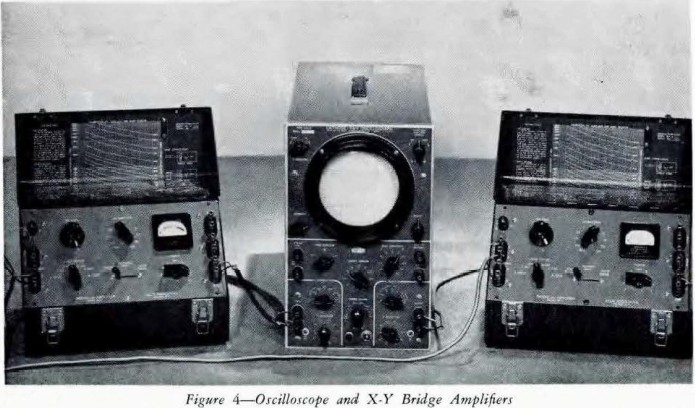
During the early 1950s, engineers such as Greer Ellis and Francis G. Tatnall explored methods of recording dynamic stress-strain behavior using electronic instrumentation.
Their work addressed an important engineering challenge: measuring material behavior under rapidly changing loads, including shock, vibration, and high-speed deformation.
In their paper, Stress-Strain Records at High Straining Rates, Ellis and Tatnall described techniques for capturing dynamic load-deformation relationships using strain gauges, bridge amplifiers, and a Dumont 304-A oscilloscope.
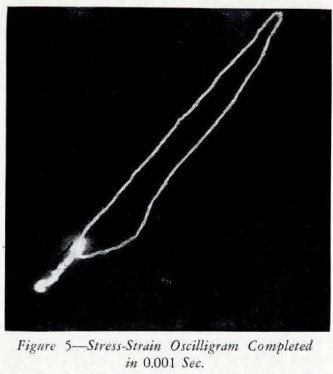
By using the CRT’s horizontal and vertical deflection capabilities, researchers could display relationships between two electrical signals in real time.
This was an important development in experimental measurement. Rather than recording only how a signal changed with time, engineers could visualize how one measured variable changed relative to another.
That same general principle became essential to the interpretation of eddy current signals.
Why Cathode Ray Tubes Were Important to Eddy Current Testing
Early eddy current instruments needed a practical means of displaying changes in the electrical response of an inspection coil.
When a probe approaches an electrically conductive material, electromagnetic coupling changes the coil’s electrical characteristics. Material conductivity, magnetic permeability, probe lift-off, and discontinuities can influence the resulting response.
An instrument must detect these changes and present them in a form that an inspector can interpret.
CRT-based displays provided an effective solution.
Depending on the instrument design, the horizontal and vertical deflection circuits could display two related signal components. This made it possible to observe changes in amplitude, phase, and signal trajectory.
The familiar impedance-plane display became one of the defining features of eddy current instrumentation.
Although modern instruments use digital displays, the underlying electromagnetic relationships remain the same.
The importance of early CRT instrumentation is documented in the National Bureau of Standards publication Eddy Current Nondestructive Testing (NBS Special Publication 589, 1981). In his discussion of pulsed eddy current techniques, D. L. Waidelich describes how early inspection systems used cathode-ray oscilloscopes to display electromagnetic responses, including differences associated with discontinuity depth.
Friedrich Förster and the Development of Practical ECT Instruments
Dr. Friedrich Förster played a major role in transforming eddy current testing into a practical industrial inspection method.
His work contributed to the development of instruments capable of evaluating material properties and detecting discontinuities through electromagnetic measurements.
Early electronic displays, including CRT-based instrumentation, provided a means of observing and interpreting inspection responses.
These developments helped move eddy current testing beyond relatively simple comparative measurements toward more sophisticated signal analysis.
Förster’s contributions are part of a much broader history of electromagnetic research, instrumentation, and industrial nondestructive testing.
You can learn more about his contributions in our Pioneers of Eddy Current Testing directory.
Hugo Libby and Multifrequency Eddy Current Testing
Another important contributor was Hugo L. Libby, whose research helped advance multifrequency and multiparameter eddy current techniques.
Libby’s work addressed a challenge that remains important today: separating the effects of different inspection variables.
An eddy current signal may be influenced by several conditions simultaneously, including conductivity, permeability, geometry, lift-off, and material discontinuities.
By using multiple test frequencies and analyzing their responses, researchers could obtain additional information and improve the discrimination of competing variables.
For more about Libby’s contributions to practical multifrequency systems, read The Forgotten Bridge: How Hugo Libby Turned Theory into Multifrequency Testing Reality.
Early analog instrumentation required careful interpretation of displayed signals. The ability to visualize signal relationships was therefore an important part of developing and applying these techniques.
Modern multifrequency instruments accomplish far more through digital signal processing, but they continue to build upon the electromagnetic principles explored by these early researchers.
Libby and other contributors are also featured in our ECT historical contributors directory.
The Evolution of CRT Eddy Current Testing Instruments
One of the most important developments in eddy current testing was the ability to display signal information in two dimensions.
In an impedance-plane representation, changes associated with resistance and inductive reactance can be expressed as components of a complex electrical quantity.
In practical ECT instruments, however, the displayed horizontal and vertical axes may represent processed signal components rather than direct measurements of coil resistance and reactance.
This distinction is important.
The impedance phase angle associated with an electrical circuit is not necessarily the same as the displayed signal phase angle used for inspection and flaw evaluation.
Modern instruments provide capabilities that early CRT-based systems could scarcely approach, including digital filtering, multifrequency mixing, automated data recording, signal processing, and sophisticated analysis software.
An important milestone in that transition is examined in From CRTs to Confidence: How Battelle’s 1984 Vision Set the Stage for Today’s Eddy Current Automation.
Nevertheless, technicians still interpret signal direction, amplitude, phase, and shape to distinguish relevant indications from interfering variables.
The display technology has changed dramatically. The need to understand the signals has not.
What Modern ECT Professionals Can Learn from CRT Instrumentation
The transition from analog CRT displays to modern digital inspection systems offers several important lessons.
First, visualization matters. A properly presented signal can reveal relationships that are difficult to recognize from numerical measurements alone.
Second, instrumentation does not replace understanding. Whether using an analog oscilloscope or a modern digital flaw detector, inspectors must understand the influence of test frequency, probe configuration, material properties, and instrument settings.
Third, technological progress builds upon earlier discoveries. Many capabilities now performed automatically were once accomplished through careful instrument adjustment, experimentation, and manual signal interpretation.
Finally, experience and technical judgment remain essential. More sophisticated instrumentation does not eliminate the need to recognize signal limitations, understand interference, and evaluate inspection results critically.
Preserving the History of Eddy Current Testing
Cathode ray tubes have largely disappeared from modern inspection equipment, replaced by digital displays and software-based signal processing.
Yet their influence remains visible every time an eddy current analyst examines an impedance-plane display, evaluates phase relationships, or interprets the movement of a signal across a screen.
The history of eddy current testing is not simply a history of instruments. It is the story of researchers, engineers, and inspectors developing increasingly effective ways to understand electromagnetic behavior.
From early oscilloscopes to today’s advanced inspection platforms, the tools have evolved—but the importance of sound physics, careful observation, and informed interpretation remains.
The evolution of CRT eddy current testing demonstrates how early analog instrumentation established visualization techniques that remain essential to modern electromagnetic inspection.
Explore more: Visit EddyCurrent.com’s Pioneers of Eddy Current Testing to discover the scientists and engineers who helped shape electromagnetic nondestructive testing.