
Why We Still Call It a “Lissajous Screen” — Even Though It Isn’t One
And why that actually tells you something important about eddy current testing

If you’ve been around eddy current testing long enough, you’ve heard it:
- “Watch the Lissajous Screen”
- “Rotate the Lissajous”
- “Watch how the signals rotate on the 4-Liss display”
And yet… if we’re being technically honest:
👉 Modern eddy current instruments do not display Lissajous patterns
👉 They display impedance traces on the impedance plane
So how did we end up calling it something else?
The Discovery That Changes the Timeline
That’s what I thought too.
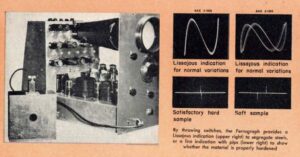
Until I came across a 1946 issue of American Machinist in my archives.
It didn’t introduce the term.
It didn’t explain the term.
It just used it:
- “Lissajous indication for normal variations”
- “Differences in amplitude of the Lissajous patterns…”
👉 Like everyone already knew what it meant.
By 1946, “Lissajous” was already part of the working vocabulary in electromagnetic inspection.
Where the Term “Lissajous” Actually Came From
Long before eddy current testing, engineers were using oscilloscopes in X–Y mode.
Apply one signal to X and another to Y…
…and you get:
- circles
- ellipses
- figure-eight patterns
These were called Lissajous figures, used to visualize phase relationships.
Sound familiar?
It should—because eddy current testing is fundamentally about phase analysis.

What Eddy Current Instruments Actually Show


What we’re really looking at in eddy current testing is:
- resistance (horizontal axis)
- reactance (vertical axis)
- phase angle
- vector movement
👉 That’s an impedance plane
Not a true Lissajous figure.
The physics is different—even if the display looks similar.
The Real Names (That Didn’t Stick)
They used terms like:
- vector display
- vector scope
- sigma scope
Technically correct.
Scientifically precise.
And completely ignored in the field.
Why the “Wrong” Term Won
By the time these instruments hit the field:
👉 The users already knew oscilloscopes
👉 They already knew Lissajous patterns
So when they saw the screen?
They didn’t say:
“Ah yes, a complex impedance vector representation.”
They said:
👉 “That’s a Lissajous.”
And that was the end of it.
What This Means for You as a Technician

If you only think in terms of “Lissajous,” you may:
- rely on pattern recognition
- miss deeper meaning
- struggle with interpretation
But if you think in terms of impedance plane physics:
- phase → depth
- amplitude → strength
- rotation → geometry/material effects
👉 That’s when things start to click
Should We Stop Saying “Lissajous”?
No.
It’s everywhere:
- training programs
- procedures
- certification exams
- everyday language
It’s not going anywhere.
The Right Way to Think About It
Use both:
- Say “Lissajous”
- Think “impedance plane”
That’s how experienced analysts operate.
Final Thought
-Eddy current testing wasn’t shaped just by scientists.
-It was shaped by the people using the equipment.
And they chose the language that made sense to them.
That’s why “Lissajous” survived.
Want to Go Deeper?
👉 Visit eddycurrent.com
- Learn real signal interpretation
- Explore historical foundations
- Build true Level II / Level III understanding
Because at the end of the day…
👉 It’s not what you call the screen
👉 It’s whether you understand what it’s telling you